How to Choose Your First Data Certification
A practical decision guide for choosing between cloud, BI, AI, analytics engineering, and data engineering certifications without wasting months on the wrong path.
The best first data certification is not the one with the most famous logo. It is the one that teaches the skills you will actually use in your next role, gives you enough structure to study consistently, and proves something an employer can understand. That sounds obvious, but many learners start with a hard cloud associate exam before they know basic SQL, or they choose an AI certification before they can explain how data is stored, cleaned, and governed.
A certification should be a forcing function. It should make you read the official exam guide, build small examples, practise scenario questions, and turn vague interest into a visible learning path. If it does not do that, it becomes an expensive badge with very little practical value.
Start with the job you want next
The right first certification depends on the work you want to be trusted with. If you want to become a data analyst, you need reporting, dashboarding, business metrics, data modelling basics, and enough SQL to investigate numbers without waiting for someone else. A Power BI, Tableau, or cloud data fundamentals path is usually more useful than a deep infrastructure certification.
If you want to become a data engineer, your first certification should move you toward pipelines, storage, orchestration, distributed processing, and data quality. That could mean a Microsoft Fabric or Azure data exam, AWS Data Engineer Associate, Google Professional Data Engineer, Databricks Data Engineer Associate, SnowPro Core, or dbt Analytics Engineering, depending on the tools you are likely to touch.
If you want to work around AI, do not jump straight to model architecture unless you already have the foundations. Most practical AI work depends on data preparation, retrieval, evaluation, governance, and deployment decisions. A good AI fundamentals certification should help you understand terms like tokens, embeddings, retrieval augmented generation, model evaluation, and responsible AI before you try to design production systems.
Use a simple certification map
Think of data certifications in five lanes. The lanes overlap, but each one trains a different kind of judgment.
Cloud fundamentals certifications help you understand accounts, regions, identity, networking, storage, databases, analytics services, monitoring, and cost. They are a strong first step if cloud terminology still feels unfamiliar. They are also useful if you are moving from business analysis into technical delivery.
Business intelligence certifications focus on turning data into decisions. You learn data preparation, semantic models, measures, visual design, sharing, governance, and performance. This is the best lane if your target work is dashboards, reporting, executive packs, metric definitions, or self-service analytics.
Data engineering certifications focus on reliable data movement. You learn ingestion, transformation, storage formats, orchestration, partitioning, testing, access control, monitoring, and recovery. This is the lane for pipeline builders and platform teams.
Analytics engineering certifications, such as dbt, sit between BI and engineering. They are valuable if you want to build trusted SQL models, document transformations, test assumptions, and create reusable data assets that analysts can depend on.
AI and machine learning certifications are best when you already understand enough data foundations to reason about inputs, quality, privacy, and evaluation. For many learners, AI fundamentals should come before advanced machine learning engineering.
Do not confuse popularity with fit
A popular certification can still be the wrong first move. AWS Solutions Architect Associate is respected, but it covers a wide cloud architecture surface. If your immediate goal is a Power BI analyst job, it may teach useful background while delaying the skills employers expect you to demonstrate in interviews.
The same applies to advanced platform exams. A Databricks Professional or Google Professional Data Engineer certification can be valuable, but it will feel punishing if you have not already worked with SQL, distributed processing, cloud storage, identity, and pipeline monitoring. Difficulty is not the problem. Poor sequencing is.
A better rule is to choose the certification that is one step beyond your current ability, not five steps beyond it. You want enough stretch to grow, but not so much unfamiliar vocabulary that every practice question becomes guesswork.
Compare exams using four filters
Before you commit, score each certification against four filters: career relevance, prerequisite match, practice environment, and proof value.
Career relevance asks whether the exam maps to work you actually want. If the target role mentions Power BI, semantic models, SQL, and stakeholder reporting, a BI path is relevant. If it mentions Spark, orchestration, data lakes, and production pipelines, a data engineering path is more relevant.
Prerequisite match asks whether you can understand the exam guide today. You do not need to know every topic, but you should recognise at least half the terms. If the guide reads like a foreign language, start lower.
Practice environment asks whether you can build examples without excessive cost or setup friction. A certification is much easier to study when you can create a small dashboard, write SQL, run a pipeline, configure a storage bucket, or test a dbt model.
Proof value asks whether the certification helps a hiring manager understand what you can do. A badge alone is weak proof. A badge plus a small portfolio project, clear notes, and strong practice-question explanations is much stronger.
Recommended first paths by learner profile
If you are completely new to cloud and data, start with a fundamentals path. Learn what compute, storage, databases, identity, networking, analytics, and governance mean. Then choose BI, data engineering, or AI based on the work that interests you most.
If you already use Excel or reporting tools at work, a Power BI, Tableau, or analytics-focused path is often the fastest route to useful outcomes. Your existing business context becomes an advantage because you can connect technical concepts to real decisions.
If you already know SQL and some Python, consider a data engineering or analytics engineering path. You are ready to learn how production data systems handle reliability, testing, orchestration, lineage, and quality.
If you are a software engineer moving into data or AI, choose a cloud data or AI fundamentals exam that fills your gaps in storage, identity, governance, and data lifecycle. Your coding ability helps, but data systems fail in different ways from ordinary application features.
If your company already uses a specific platform, bias toward that platform first. A certification on the tools you can practise at work beats a more famous exam you can only study theoretically.
A practical 30-day study plan
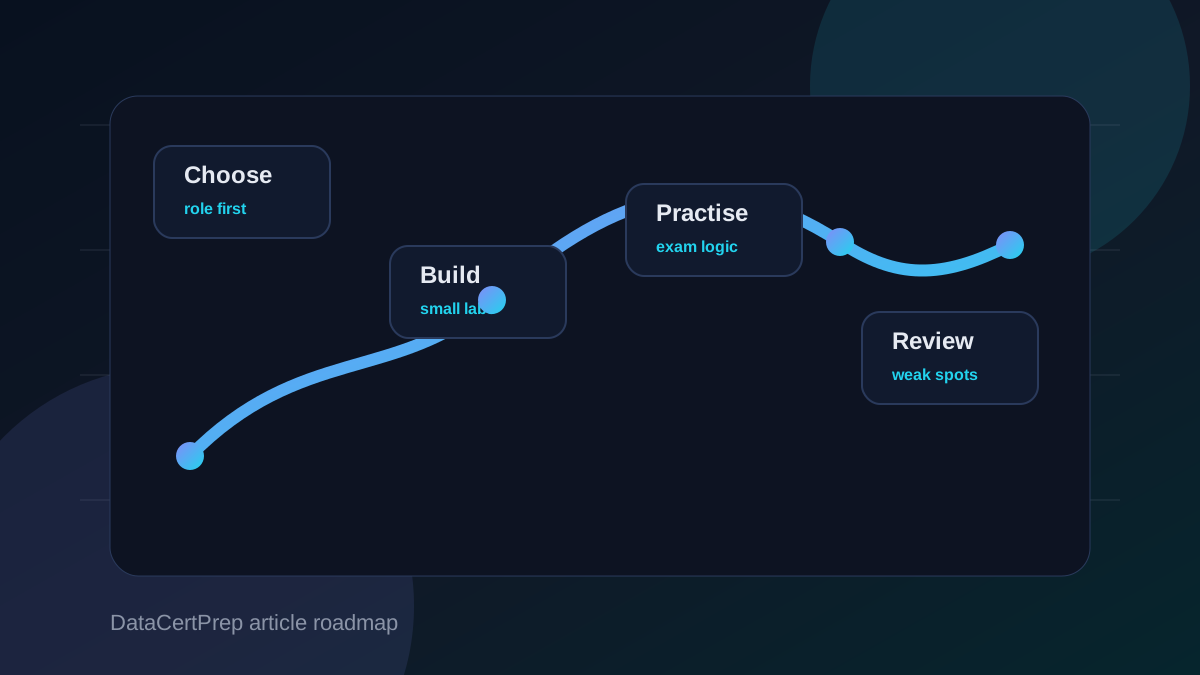
In week one, read the official exam guide and turn every domain into a checklist. Do not start by watching random videos. Start with the blueprint, because the blueprint tells you what the exam writer thinks matters.
In week two, build small examples for the highest-weighted domains. If it is a BI exam, create a tiny model and dashboard. If it is a data engineering exam, move a sample file through an ingestion and transformation flow. If it is AI fundamentals, compare prompting, retrieval, and evaluation examples.
In week three, use practice questions to find weak areas. Do not just mark right or wrong. For every missed question, write why the correct answer is right, why your answer was tempting, and what keyword or scenario clue you missed.
In week four, simulate the exam. Mix domains, time yourself, and review the mistakes by category. Most learners do not fail because they know nothing. They fail because they cannot distinguish two plausible answers under time pressure.
Common mistakes to avoid
The first mistake is collecting resources instead of studying. A long playlist, five courses, and twenty bookmarks can feel productive, but it often delays the uncomfortable work of answering questions and building examples.
The second mistake is ignoring official wording. Certification exams use precise language. Words like managed, serverless, private, least-privilege, batch, streaming, semantic, lineage, and durable are not decoration. They point to the service, pattern, or trade-off the question is testing.
The third mistake is studying only for recall. Real exam questions often describe a scenario and ask for the best option, not a definition. You need to practise reasoning: what is the constraint, what is the risk, what answer satisfies the requirement with the least unnecessary complexity?
The fourth mistake is taking the exam too early because you are bored. Boredom is not readiness. Readiness looks like stable practice scores, clear explanations for wrong answers, and confidence across every high-weighted domain.
The decision rule
Choose the certification that connects your current level to your next credible role. If you cannot explain why an exam helps you get closer to a specific job, project, or capability, pause before paying for it. Start with the path that lets you practise weekly, explain concepts in plain English, and produce evidence beyond the badge.
A first certification should not be the end of your learning path. It should be the first structured proof that you can study a technical domain, build small examples, reason through scenarios, and keep going. That is what employers notice, and it is what will make the next certification easier.